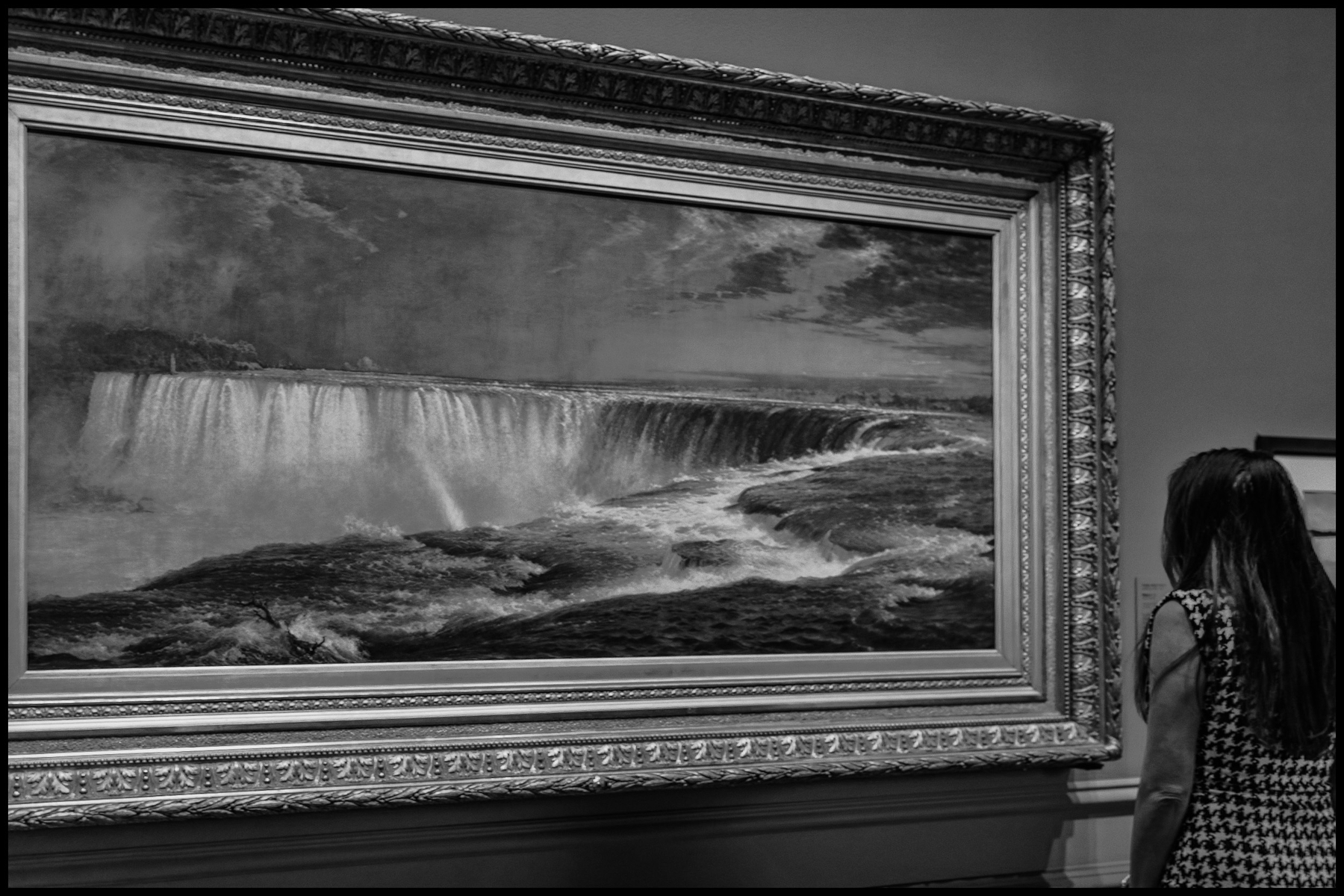
Viewing Niagra, National Gallery of Art, Washington, DC
A visitor stands before Frederic Edwin Church’s Niagara (1857) at the National Gallery of Art in Washington, D.C. When the painting debuted, audiences were stunned by its scale and sense of immediacy. Long before large-format photography, cinema, or digital media, Church created an experience that seemed to place viewers at the edge of the falls themselves. The exhibition traces how artists have interpreted Niagara over the last two centuries, from romantic spectacle to cultural symbol.
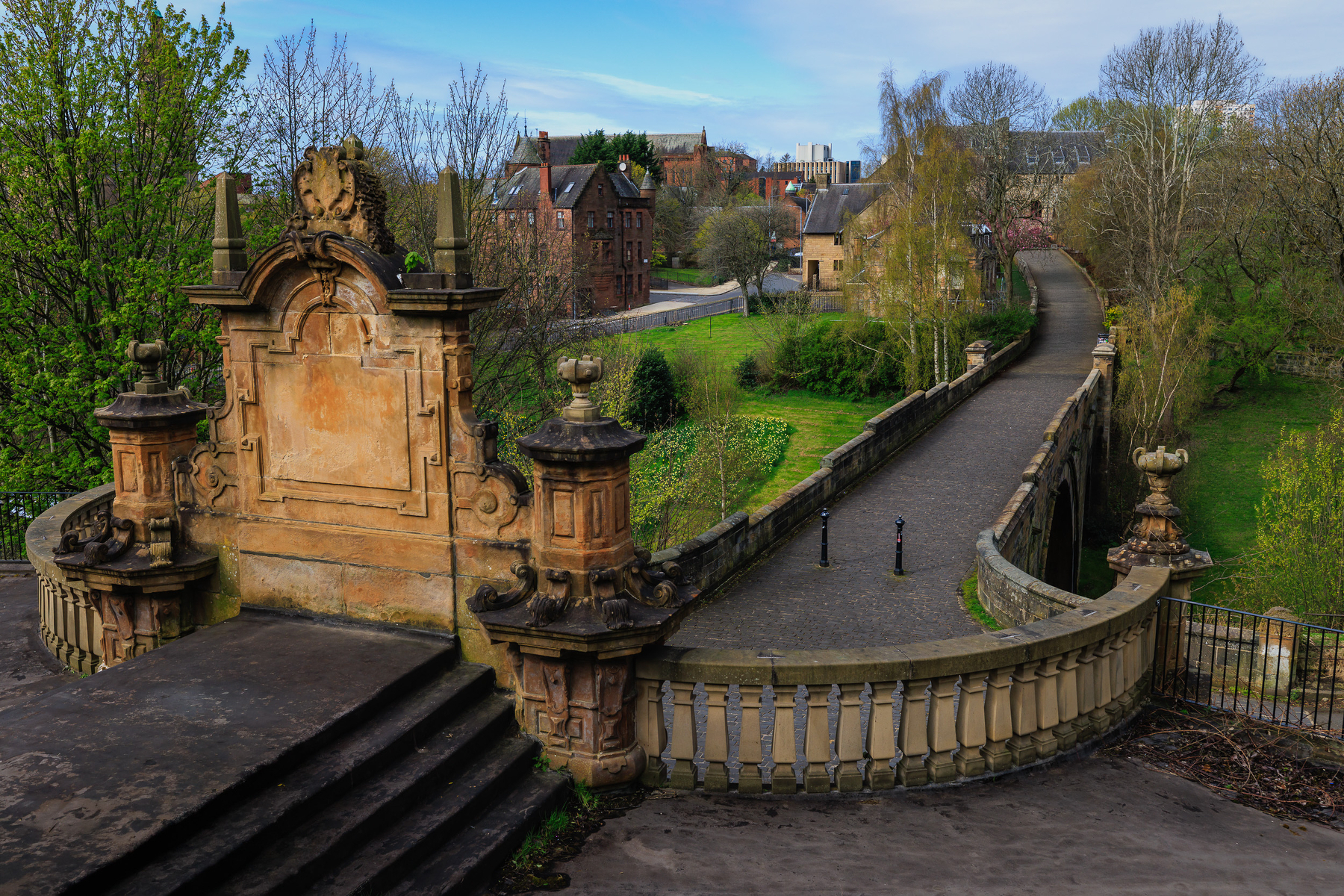
The Bridge of Sighs: Gateway to the City of the Dead
The Bridge of Sighs in Glasgow, built in 1833 by James Hamilton, crosses the Molendinar Ravine and connects Glasgow Cathedral to the Necropolis. Its name echoes the Venetian bridge, but here the “sighs” were those of funeral processions making their way to the Victorian cemetery beyond.
The stone structure in the foreground forms the bridge’s monumental gateway. The Molendinar Burn that once flowed beneath was culverted in 1877, leaving the bridge today to span a roadway and parkland rather than water.
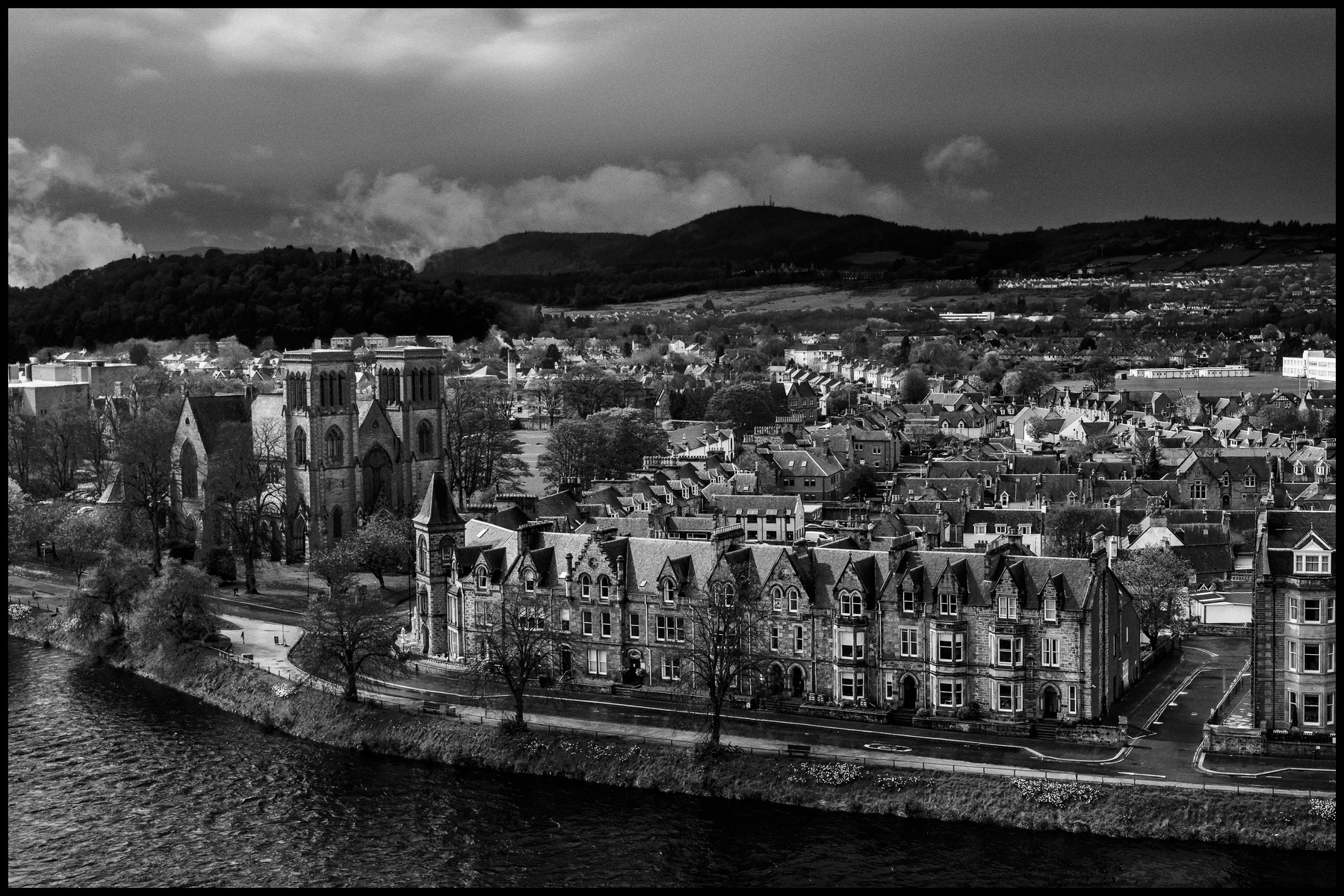
Photographers Worth Exploring - Updated
I’ve just updated my list of Photographers Worth Exploring to include the work of Sarah M. Lee. Her photography is remarkably intimate and engaging, capturing moments that feel both deeply personal and universally resonant.
You can see the full list and the new addition here: Photographers Worth Exploring
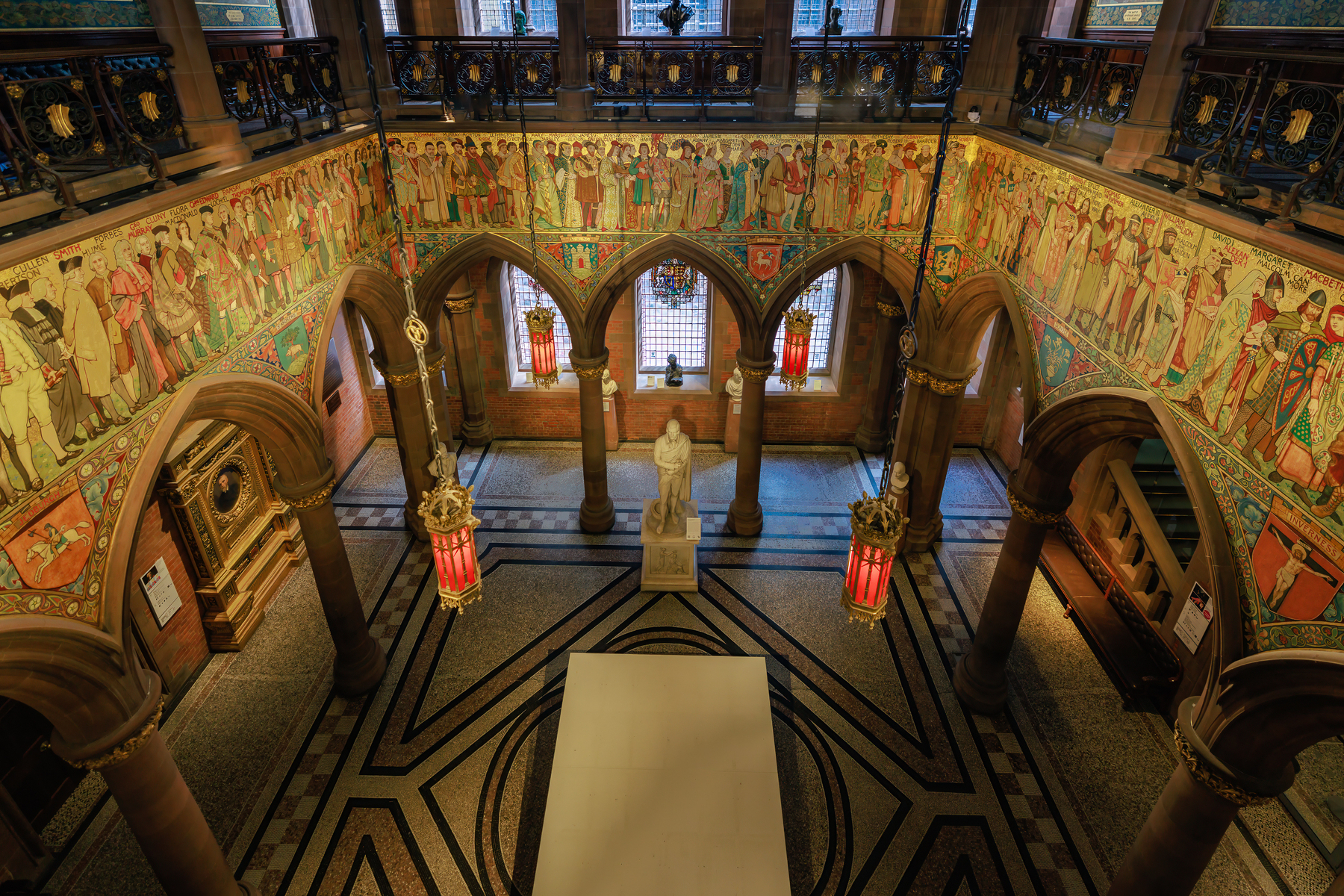
The Procession of Scotland: The Great Hall
The Great Hall of the Scottish National Portrait Gallery, opened in 1889 and designed by architect Sir Robert Rowand Anderson, was conceived as a “shrine” to Scotland’s national history. At its center stands a statue of the historian Thomas Carlyle, surrounded by Gothic arches, stained glass, and richly decorated surfaces.
Encircling the upper walls is a continuous processional frieze painted between 1897 and 1901 by the artist William Brassey Hole. The mural depicts 155 figures from Scottish history, arranged in reverse chronological order—beginning with Carlyle himself and moving back through monarchs, thinkers, and cultural figures to the nation’s prehistoric inhabitants. Each figure is labeled and dressed according to their period, forming a visual narrative of Scotland across time.
Executed in a spirit fresco technique, the frieze was part of the original decorative scheme funded by the gallery’s founder, John Ritchie Findlay. It reflects a late Victorian ambition to present national identity through art, assembling a collective portrait of Scotland within a single, immersive architectural space.
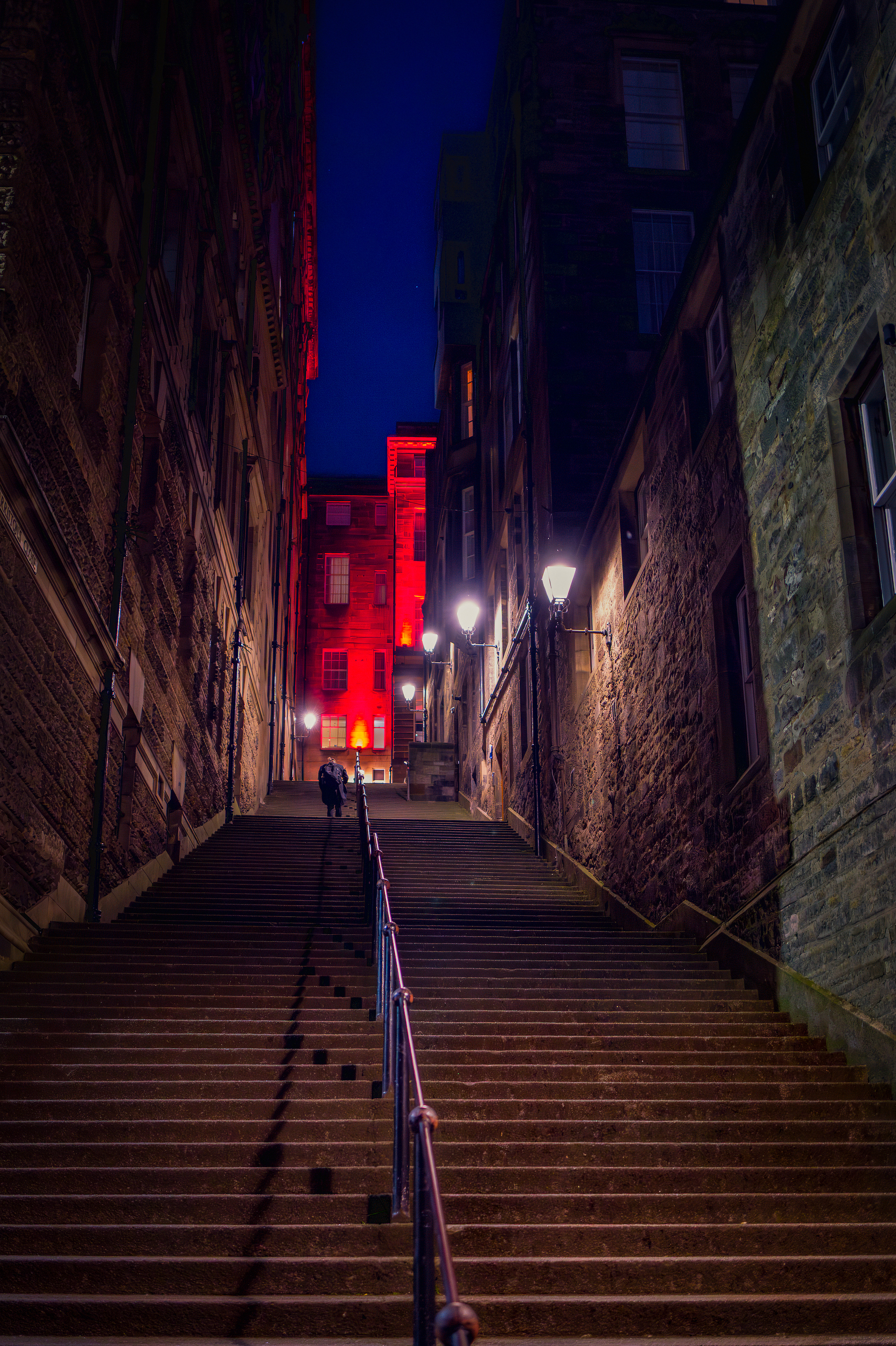
The Crimson Ascent
A solitary figure climbs the steep steps of Warriston’s Close, one of the historic “arteries” of Edinburgh’s Old Town. Named for the 17th-century Scottish lawyer and statesman Sir Archibald Johnston, Lord Warriston, this narrow passage has seen centuries of legal and political intrigue. Today, the ancient stone walls—some of the tallest of their era—serve as a dark canvas for the modern city’s vibrant night light, bridging the gap between Scotland’s storied past and its electric present.
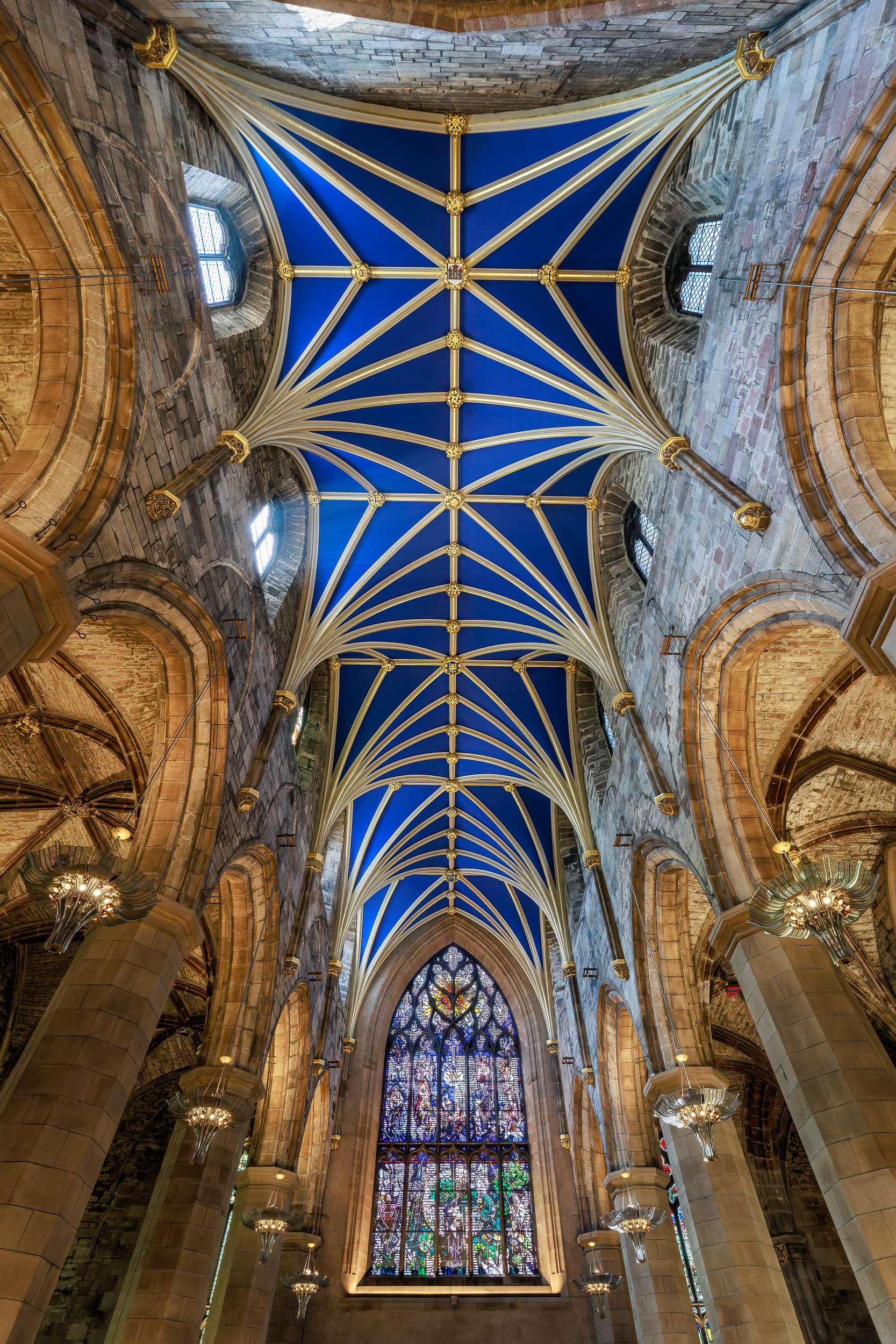
Blue Vault, St Giles’, Edinburgh
The vaulted ceiling of St Giles’ Cathedral, on the Royal Mile in the heart of Edinburgh.
Despite its name, St Giles’ is not technically a cathedral. A cathedral is defined as the seat of a bishop, and since the Scottish Reformation in the 16th century, the Church of Scotland has not maintained bishops in the traditional sense. St Giles’ is therefore a parish church, though its scale, history, and national importance have long earned it the title “High Kirk of Edinburgh.”
Founded in the 12th century and closely associated with the Protestant reformer John Knox, the church played a central role in Scotland’s religious transformation. Its richly restored interior—especially the vivid blue vaulted ceiling with gold detailing—draws the eye upward, combining medieval structure with later decorative ambition.
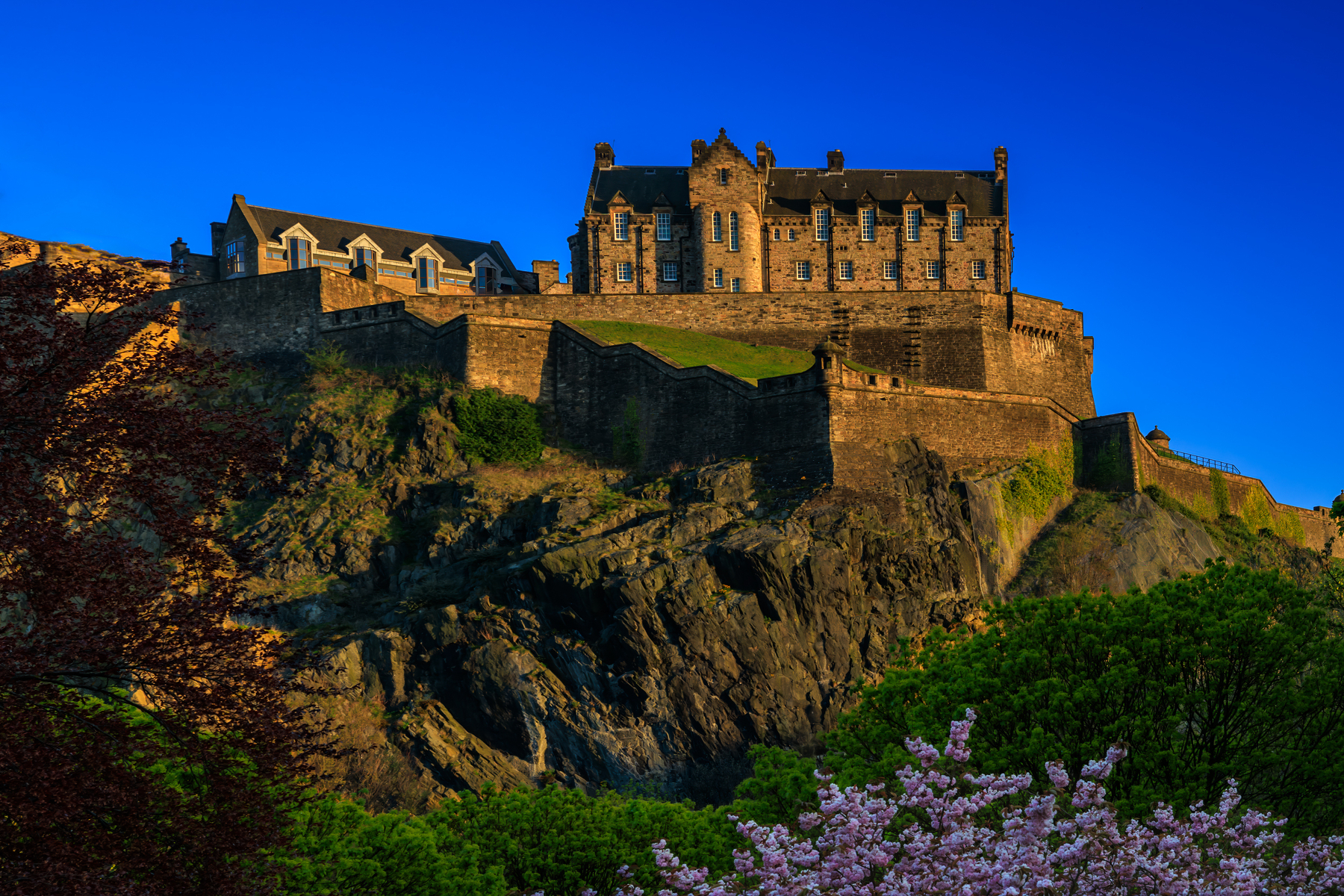
Edinburgh Castle
A study in architectural resilience atop a 350-million-year-old volcanic plug. While the site’s history reaches back to the Iron Age, the oldest standing structure is St Margaret’s Chapel, dating to 1130. This view highlights the transition from 12th-century Romanesque beginnings to the Scottish Baronial fortifications added through the 16th century. The massive Half Moon Battery and the Royal Palace walls demonstrate how the castle evolved from a medieval stronghold into a royal residence, standing as a 900-year timeline of Scottish masonry.
Iona, Scotand
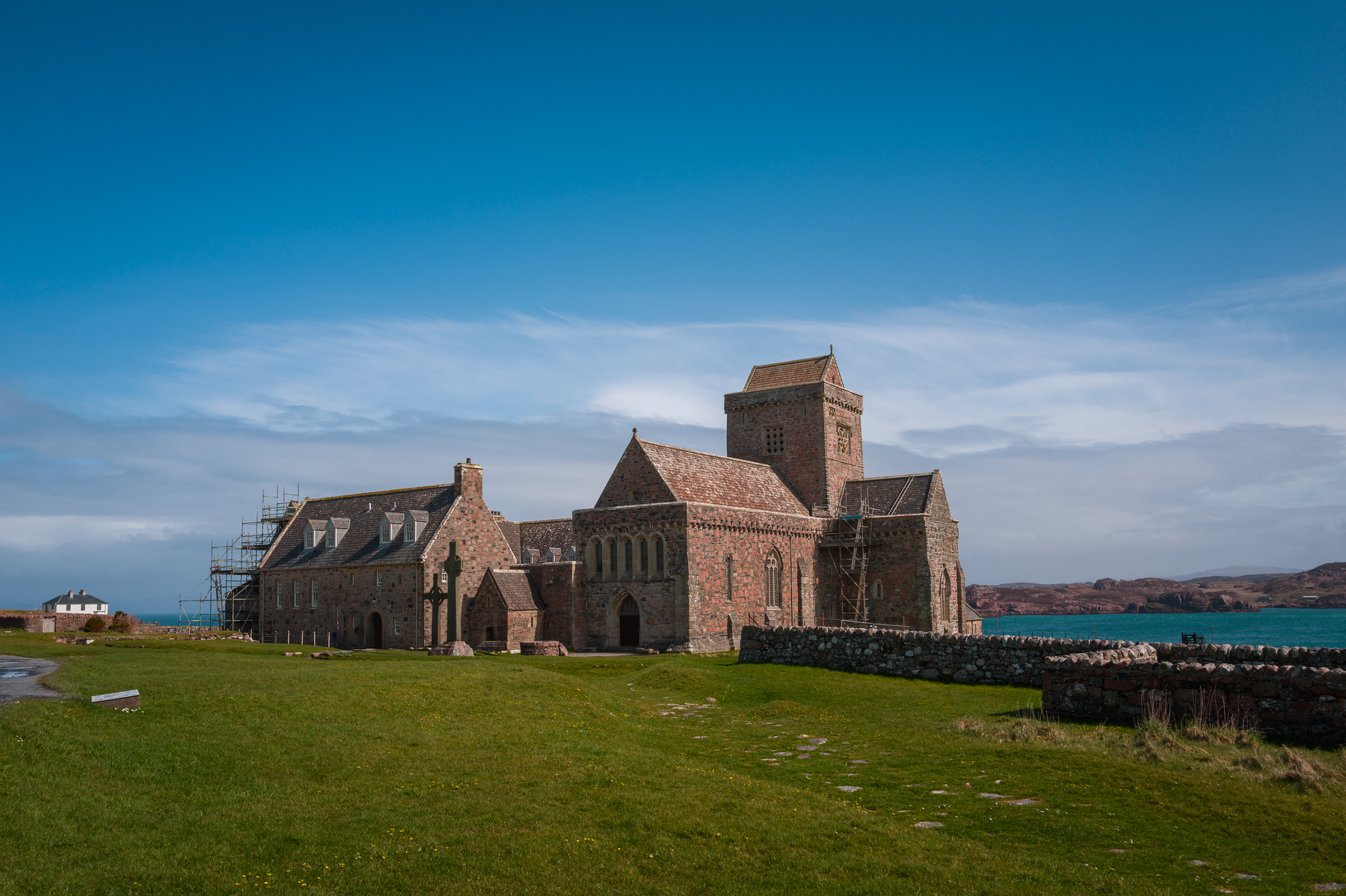
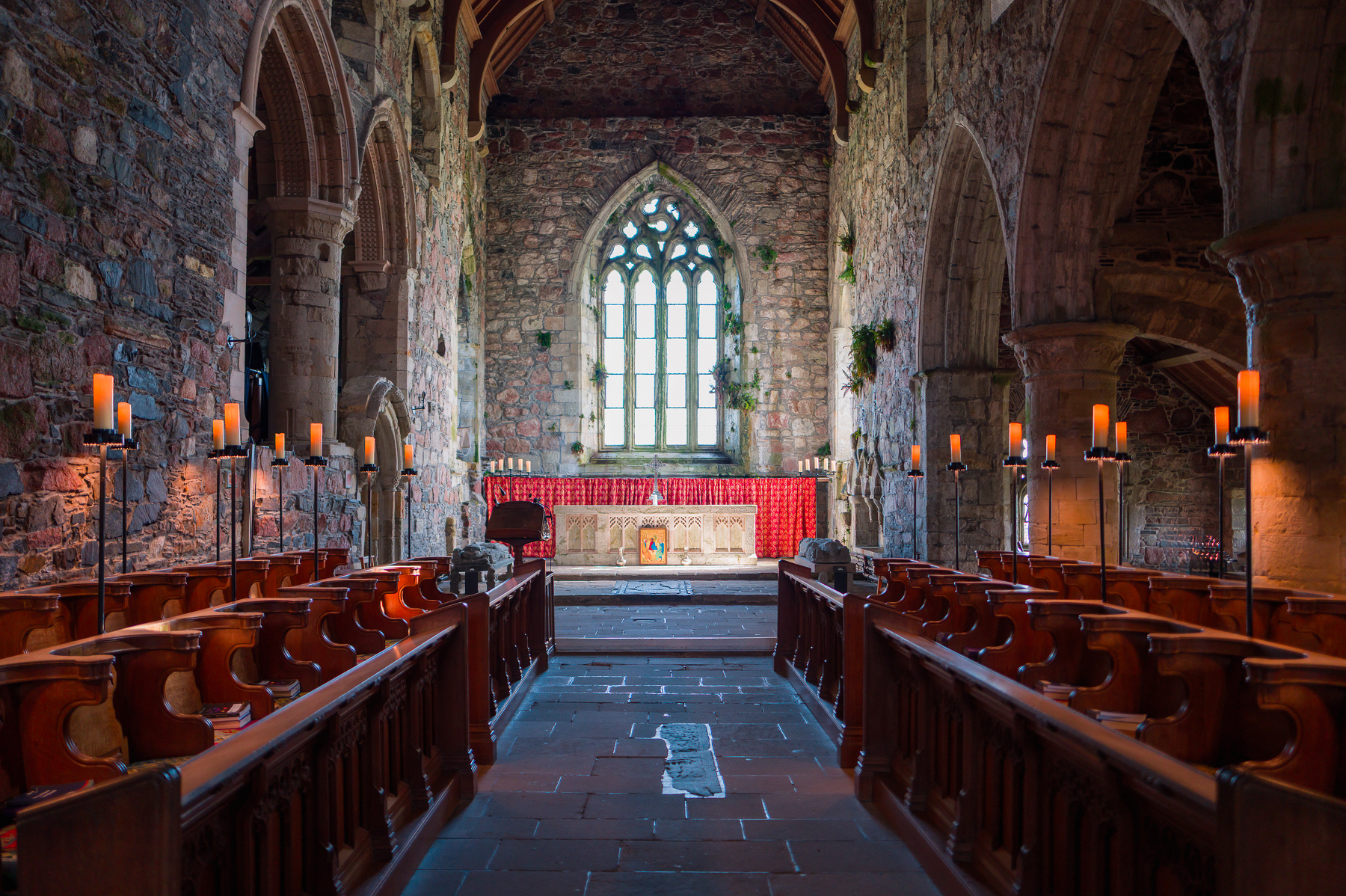
Iona Abbey stands on one of the most historically significant religious sites in the British Isles.
The abbey traces its origins to the year 563, when the Irish monk Saint Columba arrived on the island of Iona with a small group of followers. From this remote outpost, he established a monastery that became a major center of early Christianity in Scotland and northern England. Iona played a key role in the spread of Christianity among the Picts and Scots, and for centuries it was a place of learning, manuscript production, and missionary activity. The famous Book of Kells is believed to have originated here before being taken to Ireland during periods of Viking raids.
Despite its isolation, Iona’s location was deliberate. In the 6th century, remoteness offered both spiritual and practical advantages: separation from worldly life for monastic devotion, and a position on maritime routes that allowed monks to travel and spread their teachings across the western seaways.
The original monastery declined after repeated Viking attacks beginning in the late 8th century, and the site later became part of a Benedictine abbey founded in the 12th century. Much of the present structure reflects medieval rebuilding and later restoration, particularly a major reconstruction in the early 20th century that returned the abbey to active religious use.
Today, Iona Abbey remains a place of worship and pilgrimage, symbolizing the enduring influence of early Celtic Christianity and its role in shaping Scottish religious and cultural identity.
The Sentinel of Eilean Musdile
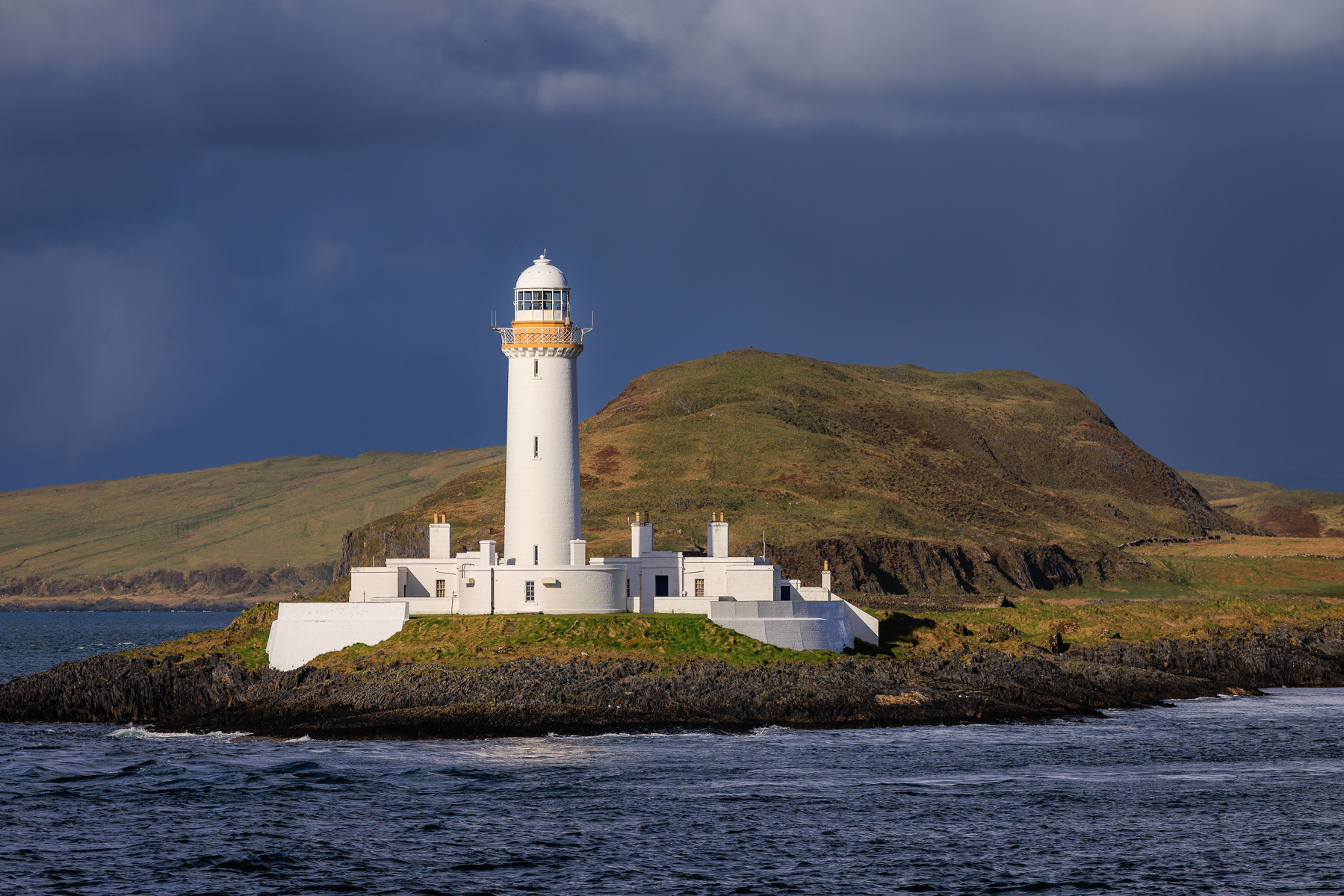
Standing at the southwestern entrance to the Sound of Mull, the Lismore Lighthouse (also known as Eilean Musdile) serves as a vital guardian for mariners navigating the Firth of Lorn toward the Inner Hebrides. This historic structure was designed and built in 1833 by the renowned civil engineer Robert Stevenson. A titan of Scottish engineering, Stevenson was the patriarch of a “lighthouse dynasty” and the grandfather of the celebrated author Robert Louis Stevenson. For nearly two centuries, his design has withstood the volatile Atlantic weather of the Argyll coast, remains a testament to the enduring legacy of the Stevenson engineers.
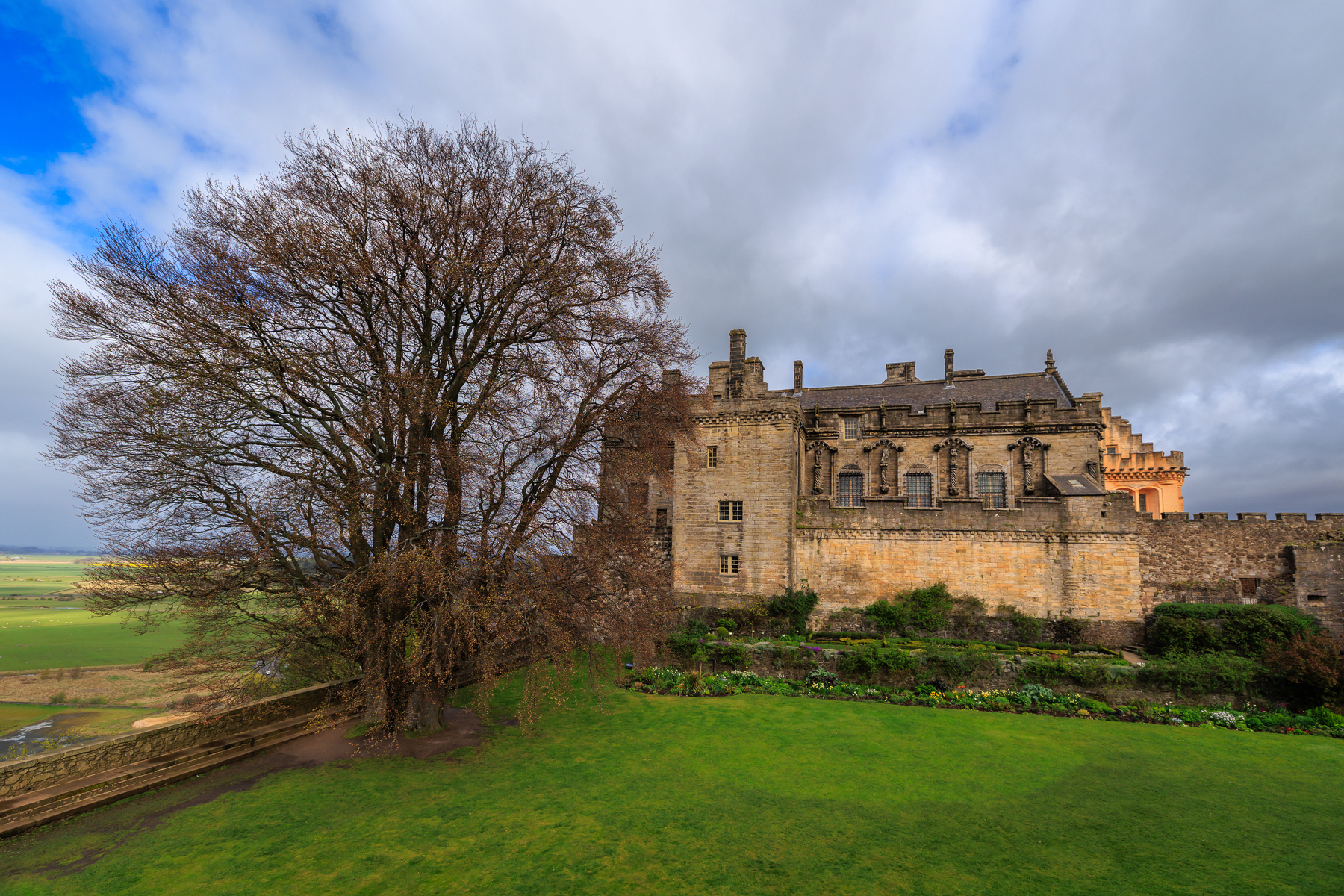
Stirling Castle: The Gateway to the Highlands
Stirling Castle rises above the surrounding countryside, positioned at one of the most strategically important locations in Scotland. Perched on a volcanic crag, it overlooks the River Forth and the natural route between the Highlands and the Lowlands.
For centuries, control of Stirling meant control of Scotland. The castle played a central role during the Wars of Scottish Independence, including the nearby battles of Stirling Bridge (1297), where William Wallace defeated English forces, and Bannockburn (1314), where Robert the Bruce secured a decisive Scottish victory.
The castle later became a favored royal residence, particularly under the Stewart kings. Mary, Queen of Scots was crowned here in 1543 as an infant, and much of the present structure reflects Renaissance influences from that period.
Today, Stirling Castle stands not only as a fortress, but as a symbol of Scotland’s long struggle for independence and identity—set against a landscape that still conveys its strategic importance.
Google now offers a Gemini App for the Mac. It works well and is nice to have.
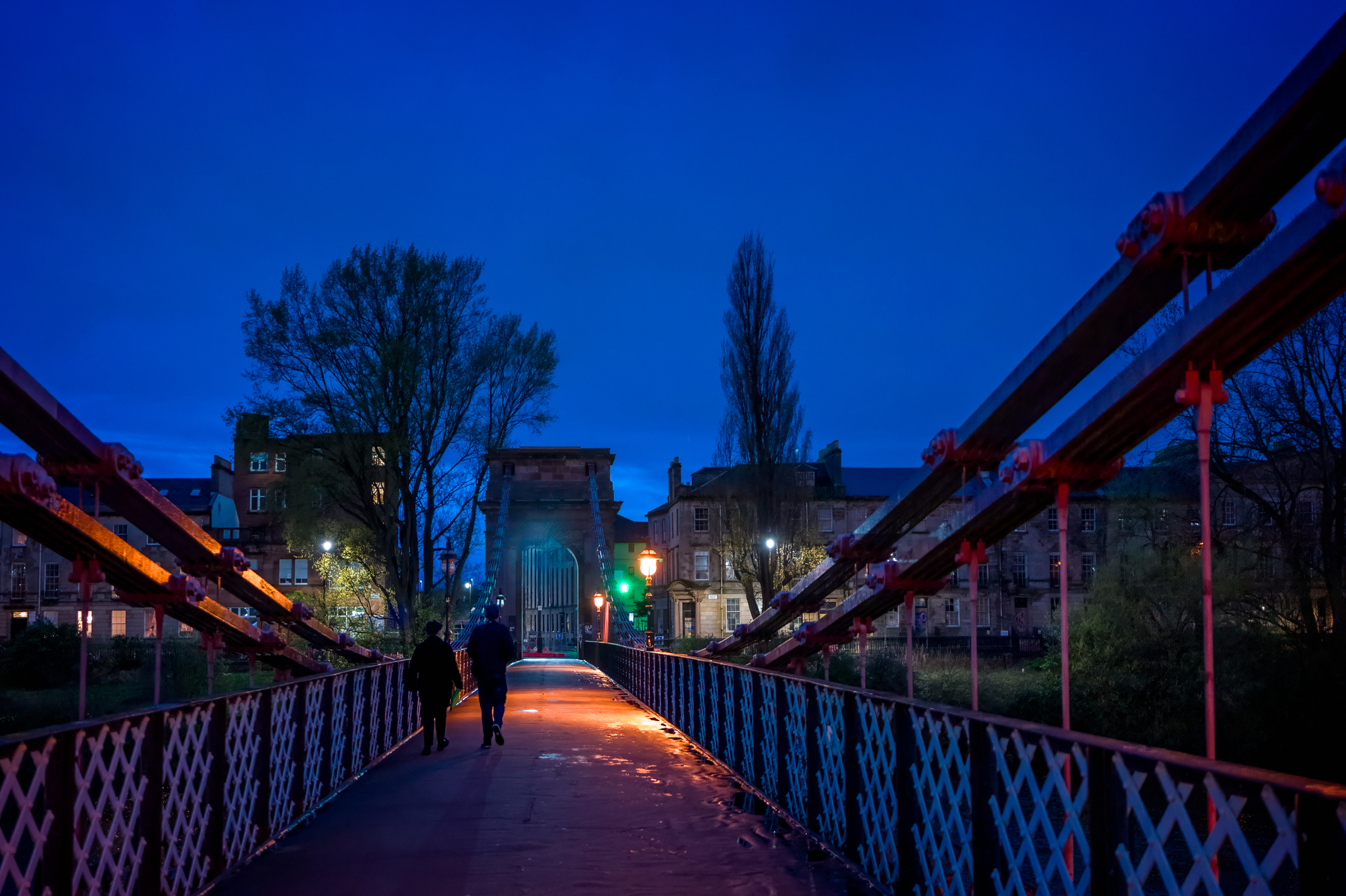
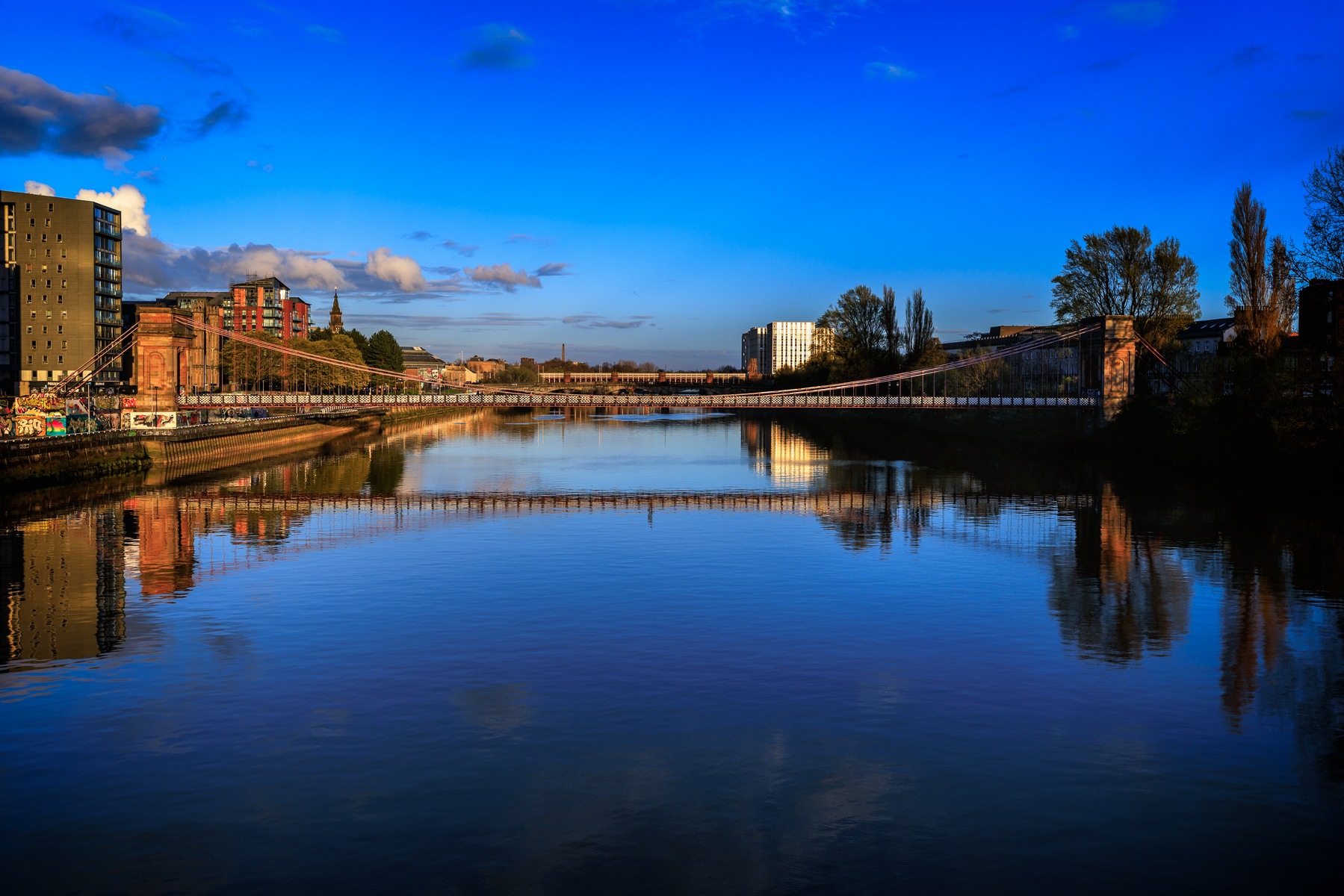
South Portland Street Suspension Bridge at Dusk, Glasgow
South Portland Street Suspension Bridge over the River Clyde, Glasgow.
Opened in 1853, the cast-iron pedestrian bridge links the city center with the south side.
The Jewish Enclosure – Glasgow Necropolis
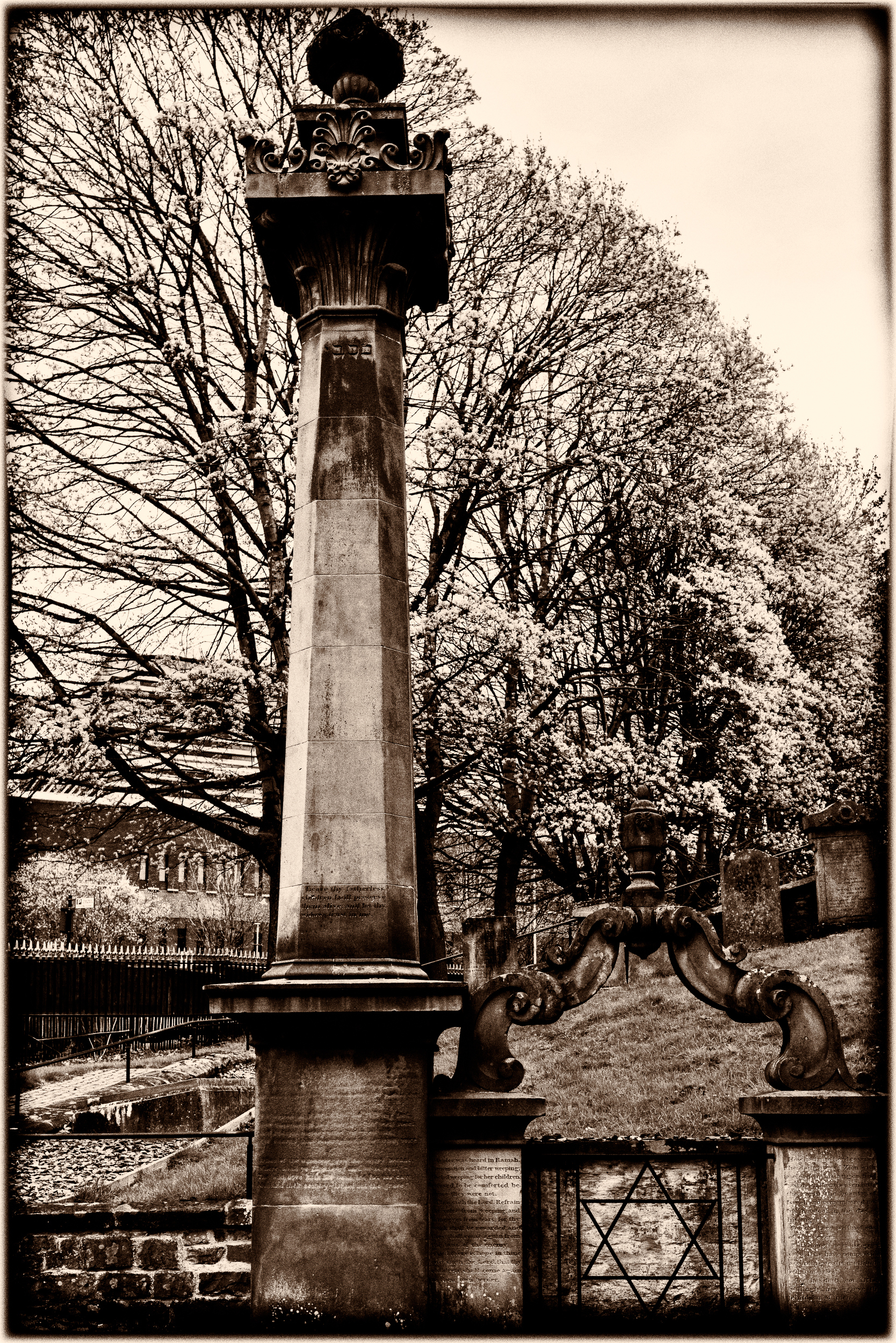
When traveling, I make it a point to seek out places of Jewish interest, and this quiet corner of Scotland holds a remarkable piece of history. This is the Jewish Enclosure at the Glasgow Necropolis. Acquired by the Jewish community in 1832, this small, walled section actually predates the official opening of the main Necropolis and served as the city’s first Jewish communal burial ground.
It contains 57 burials that took place over a brief period from 1832 until 1855. Because Jewish religious law forbids the burial of more than one person in a single grave, the small plot of land reached its capacity very quickly. As a result, it has not been in use since the 1850s. The prominent stone column, designed by architect John Bryce and modeled after Absalom’s Pillar in Jerusalem, stands watch over the ornate wrought-iron Star of David at the entrance.
Glasgow Mural
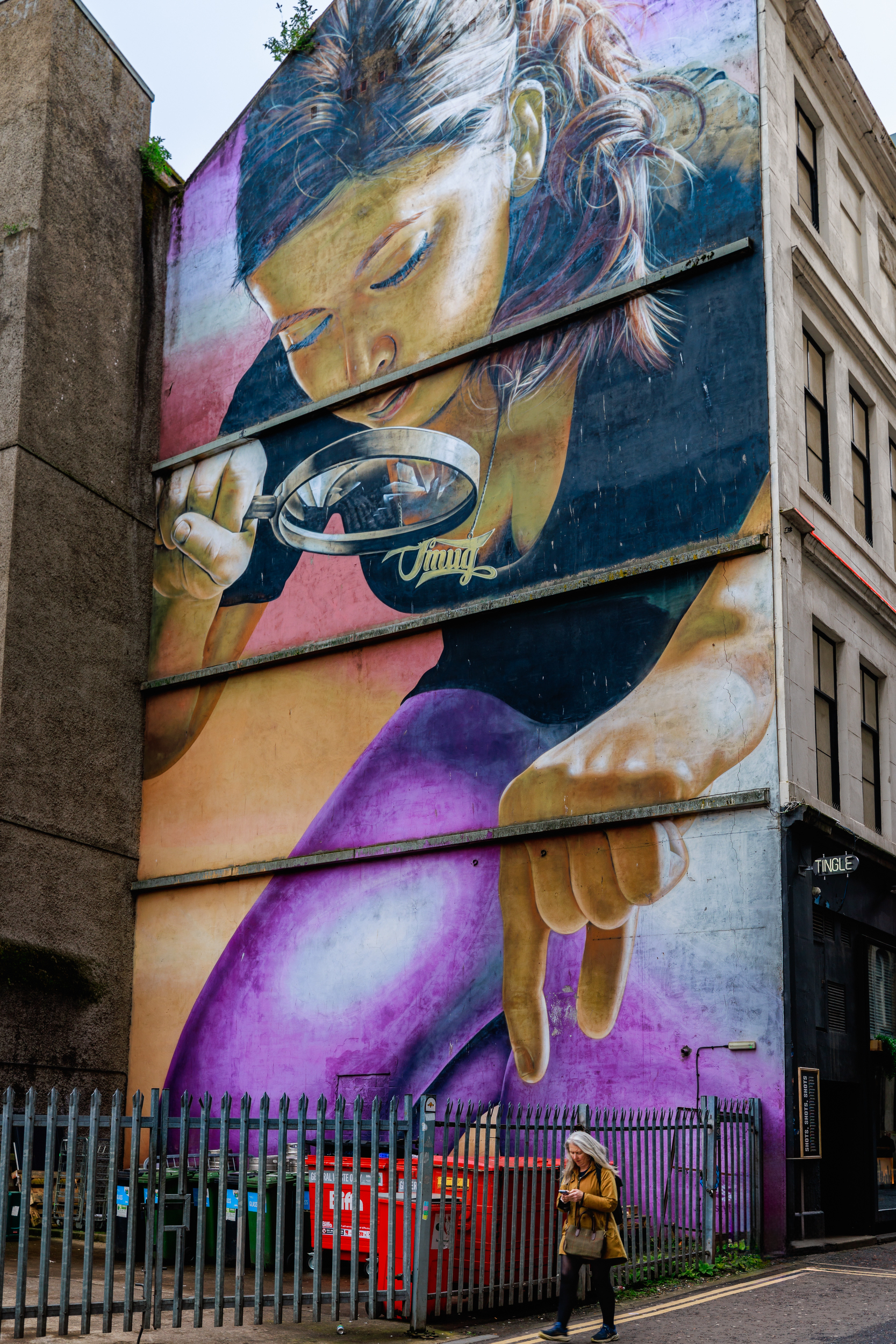
Mural by Smug (Sam Bates), a Glasgow-based artist born in Australia. One of several large works animating the city’s central streets.
St. Andrew’s Suspension Bridge, Glasgow
St. Andrew’s Suspension Bridge over the River Clyde, Glasgow. Evening light reflected across the water at sunset.
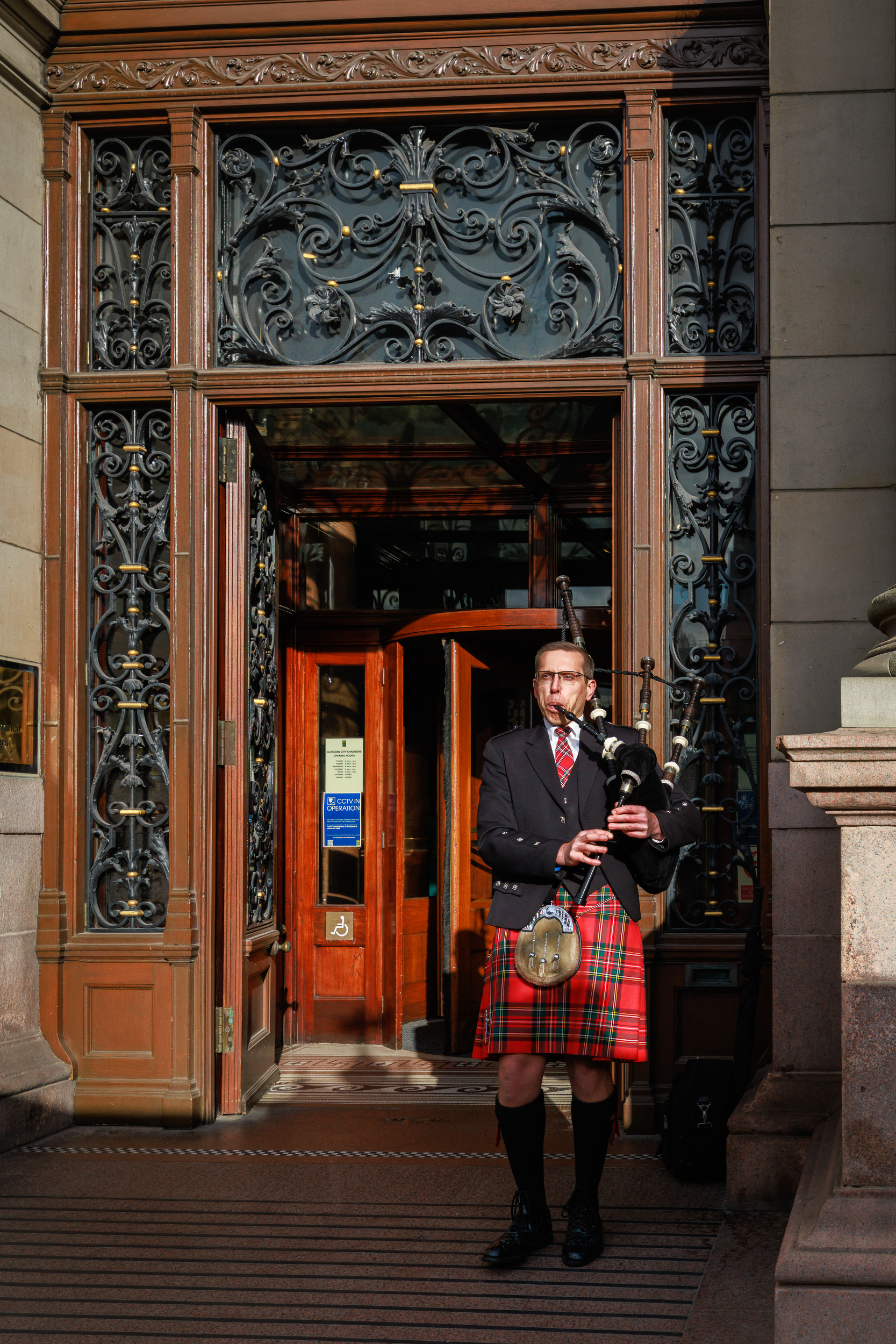
Bagpiper, Glasgow City Chambers
A bagpiper outside Glasgow City Chambers, the city’s civic headquarters on George Square. The Victorian building serves as the seat of Glasgow City Council.
Keflavik, Iceland: At the airport
Between flights in Keflavík on my way to Glasgow. A model aircraft in the Icelandair lounge set against a low northern sky. I hope to return and spend more time in Iceland.